Table of Contents
Integrating cold plunge into your daily habits can significantly benefit your overall well-being. However, establishing the right plan initially can be somewhat confusing, with one critical question always arising: When is the best time to cold plunge?
There is no single “perfect” time that works for everyone. The best time for your practice depends completely on your individual goals. Whether you want a morning surge of energy, a midday cognitive reset, or post-exercise muscle recovery. let’s find the perfect time for you.
Find Your Ideal Cold Plunge Schedule
The Morning Cold Plunge
To optimize your daily productivity, scheduling your cold plunge immediately upon waking is highly effective.
Cold exposure triggers a massive surge of dopamine, with studies showing levels can spike by up to 2.5 times, leaving you instantly alert. Unlike the temporary spike of caffeine or energy drinks, the neurotransmitter release triggered by an ice bath lasts for hours, delivering sustained focus and an elevated mood.
Beyond the physical benefits, overriding your instincts to face the cold early in the morning exercises your prefrontal cortex, building unbreakable mental toughness. It’s the ultimate brain training to help you crush demanding business decisions and heavy workloads with absolute ease.
The Afternoon Break Plunge
If you want to beat afternoon fatigue, taking a cold plunge during your afternoon break is an excellent choice.
Between 2:00 PM and 4:00 PM, our bodies naturally experience a dip in energy due to circadian rhythms. A quick cold plunge acts as a literal reset button for your central nervous system, wiping away sluggishness and snapping your brain.
Even better, it perfectly eliminates the risk of insomnia that often comes with drinking afternoon coffee.
The Evening Cold Plunge
If you want to release the day’s stress and improve your sleep quality, an evening cold plunge is an excellent choice.
It melts away the deep physical tension built up from a long day of sitting or traveling. At the same time, the cold water triggers a vagus nerve reflex, creating the ideal conditions for deep, high-quality sleep.
However, evening immersion must follow a few essential rules, or it could disrupt your sleep quality instead.
Because ice baths temporarily raise core temperature and dopamine, immediate bedtime sessions will disrupt sleep. Leaving a few hours allows your body to cool back down, ushering in deep, natural rest.
Keep the water between 10°C and 14°C, and limit your session to 2 to 5 minutes. The primary goal is simply to relax your muscles and stimulate the vagus nerve.
Put on a warm bathrobe or take a warm shower immediately after cold plunge. This prevents excessive internal heat generation and rapidly soothes your nervous system.

The Post Workout Cold Plunge
Choosing a post workout cold plunge is ideal if you want to alleviate soreness and accelerate recovery.
The cold water constricts blood vessels to control muscle micro-damage, keeping delayed onset muscle soreness (DOMS) at bay. Beyond physical recovery, it also stimulates the release of endorphins and dopamine, revitalizing the central nervous system and relieving fatigue.
However, the plunge timing depends entirely on your training type:
Plunge immediately after your session. This stops acute inflammation in its tracks and speeds up systemic recovery.
Wait at least 4 to 6 hours before plunging. Muscle growth relies on natural training inflammation as a trigger, which cold water will blunt. Never plunge right after a heavy lifting session if gains are your priority.
The Post Sauna Cold Plunge
The combination of a sauna and a cold plunge is a classic form of contrast therapy.
The core principle involves using high temperatures to dilate blood vessels, followed by low temperatures to rapidly constrict them, creating a perfect “vasomotor pump” effect. This rapidly accelerates circulation, reduces soreness, and releases dopamine to dissolve stress.
However, this extreme temperature fluctuation can cause severe physiological stress, you must prioritize safety:
Never jump straight from the sauna into the ice. Rest for 1 to 3 minutes or rinse with warm water first, then ease into the cold starting with your limbs to let your heart adjust.
Longer sessions do not mean better results. For beginners, a session of 30 seconds to 2 minutes is fully sufficient. For experienced users, keep it between 2 and 5 minutes.
Finding Your Ideal Temperature
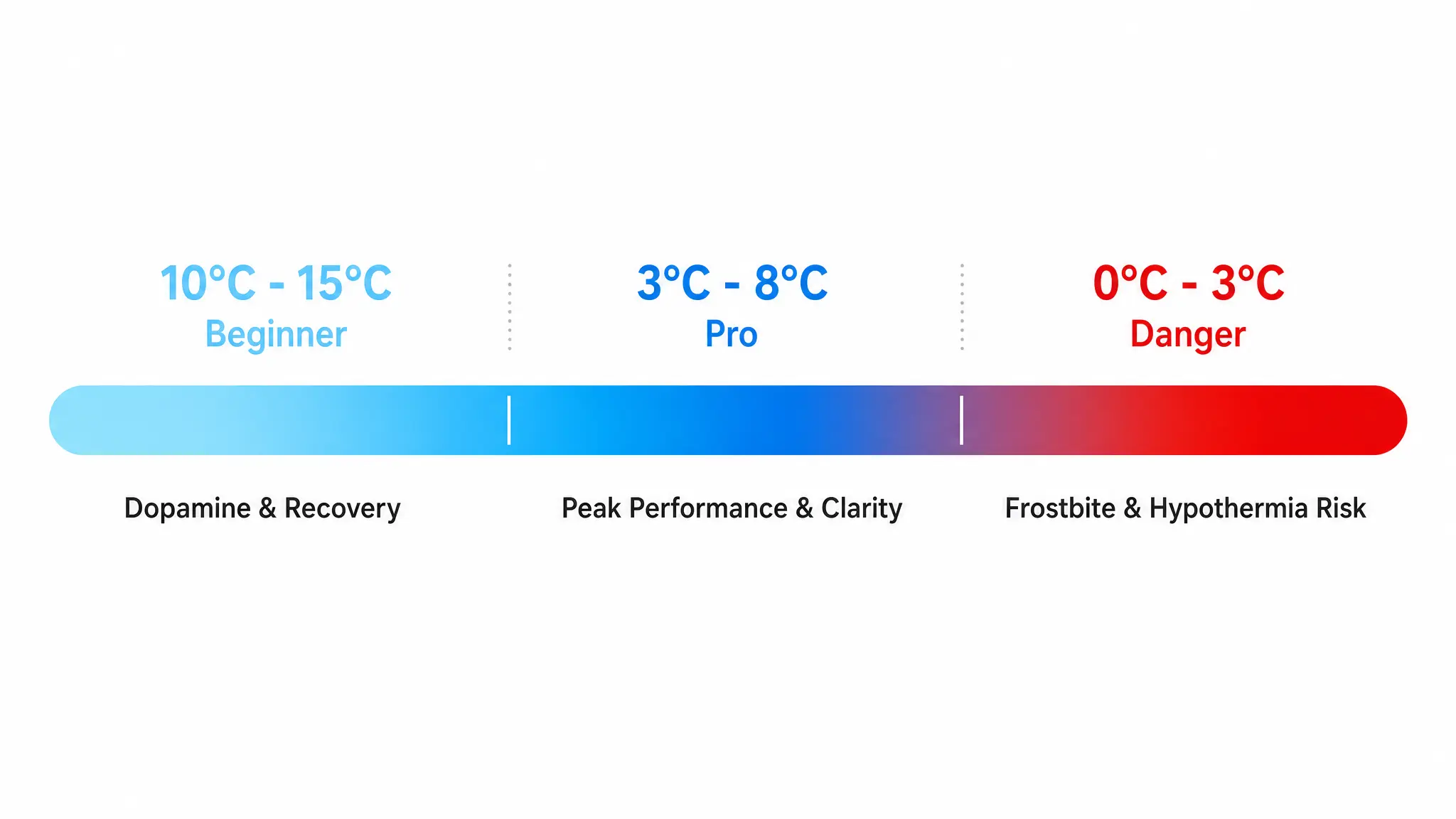
Cold Plunge for Beginners (10°C to 15°C)
Known in sports medicine as “The Sweet Spot for Beginners,” this range perfectly balances physiological benefits with safety. Clinical research shows that water below 15°C is fully capable of activating the sympathetic nervous system, triggering a powerful release of dopamine and norepinephrine, while successfully constricting blood vessels to reduce inflammation and muscle soreness.
Avoid dropping below 10°C initially, as the sudden cold shock can cause heavy gasping and unnecessary panic. The 10°C to 15°C range delivers a noticeable cold stimulus while remaining entirely manageable.
Advanced Plunging (3°C to 8°C)
Advanced users and professional athletes should look to set their water between 3°C and 8°C. When temperatures drop to around 5°C, the body’s physiological response to cold stress reaches its peak. Levels of dopamine and norepinephrine surge to three times their baseline levels. This results in exceptional mental clarity and sustained energy throughout the day.
Extreme Danger Zone (0°C to 3°C)
Many people believe colder is always better, but scientific research proves that cold therapy benefits fully peak between 3°C and 5°C. Going below 3°C offers no extra health rewards, only severe physiological risks:
Below 2°C, blood vessels contract so violently that staying in for just 3 minutes can freeze skin cells, causing permanent nerve numbness.
Near 0°C water spikes your heart rate instantly, causing involuntary gasping that can lead to drowning.
Water conducts heat over 25 times faster than air. In near freezing water, the body’s natural defense mechanisms collapse rapidly, even for highly experienced individuals.
How to Safely Experience Extreme Cold
To experience true intensity safely, do not chase 0°C stagnant water. Instead, use a circulating water system to break the thermal boundary layer.
Sitting still in an ice bath allows a thin, warm thermal layer to shield your skin. A professional cold plunge chiller continuously moves the water, washing away this shield.
Circulating water at 5°C delivers a far greater physical shock and superior therapeutic impact than a stagnant tub of 1°C water. This is why the minimum temperature of high-end cold plunger chiller on the market is typically safely limited to around 3°C, with the ultimate ice bath experience achieved through hydrodynamics.
How Long Should You Plunge?
The golden window is 2 to 5 minutes. More time does not mean more results. Exceeding this limit causes health rewards to drop significantly while sending your risk of hypothermia and frostbite into the red zone.
Your optimal timing depends on two key scientific factors:
2 to 3 minutes. Research shows your dopamine and norepinephrine surges peak within the first 2 minutes of immersion, giving you all the morning focus you need.
5 to 10 minutes. If you are bouncing back from intense training, a longer soak in milder water (10°C to 12°C) helps target muscle inflammation. If your water is under 5°C, cap the session at 3 minutes maximum.
How Many Times a Week Should You Plunge?
Aim for 3 to 4 times per week. This is the sweet spot recommended by sports medicine specialists and clinical researchers.
The underlying science points to the famous Søberg Principle, established by leading cold therapy expert Susanna Søberg. Her research proves that you only need a total of 11 minutes of cold exposure per week to activate brown fat, rev up your metabolism, and supercharge your immunity.
Consequently, the most efficient and safest approach is a routine of high frequency and short duration.
FAQ
Do not plunge if you suffer from heart conditions, hypertension, or illness. Additionally, avoid cold water for 4 to 6 hours after strength training to prevent blunting muscle growth.
Yes, 2 minutes is fully sufficient to unlock the core benefits of cold therapy. Clinical studies show that your dopamine and norepinephrine surges peak within the first 2 minutes of immersion, giving you maximum mental clarity and long lasting focus.
Yes, a quick dunk at the end is highly effective for activating the vagus nerve and calming your nervous system. Just ensure you control your breathing first to manage the sudden intensity safely.
Your body transitions from shocking to adapting, triggering sustained daily focus and faster muscle recovery. It permanently elevates your baseline energy and strengthens your resilience to daily stress.
For most people, the water should reach at least your waist or chest to get effective cold exposure. Beginners usually start with waist to mid chest depth, while more experienced users may immerse up to the shoulders.