If you are ready to build mental resilience and speed up recovery, the first question you will likely ask is: how cold is a cold plunge?
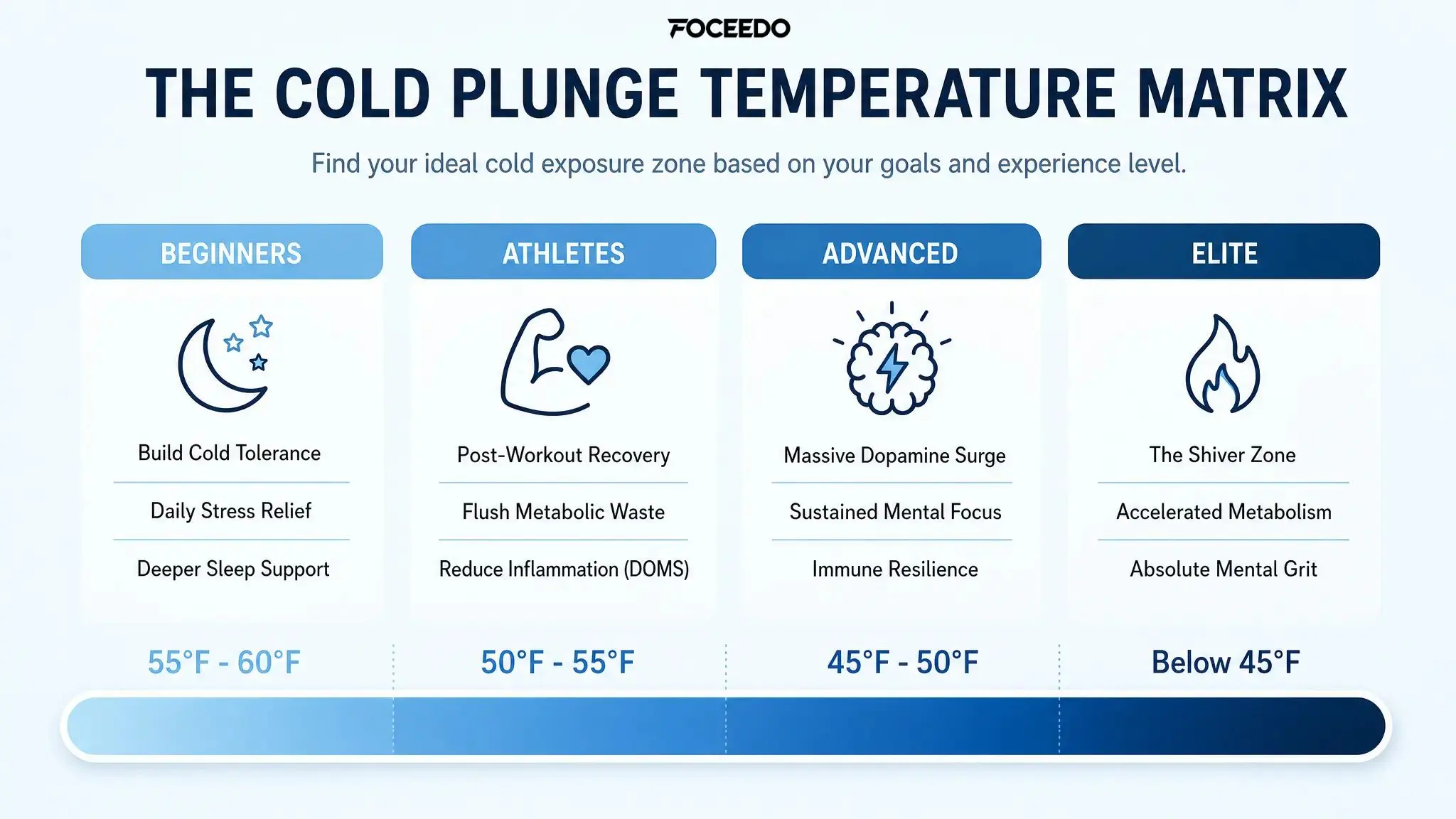
Here is a quick look at the best cold plunge temperature based on your experience and goals:
BEGINNERS
55°F–60°F / 13°C–15.5°C
Build cold tolerance and relieve everyday stress.
ATHLETES
50°F–55°F / 10°C–13°C
Reduce post-workout inflammation and speed recovery.
ADVANCED
45°F–50°F / 7°C–10°C
Maximize dopamine release and mental focus.
ELITE / EXTREME
Below 45°F / Under 7°C
Push mental resilience to the absolute limit.
Find Your Ideal Zone
Finding your ideal cold plunge temperature isn’t about freezing yourself as much as possible. It’s simply about listening to your body and matching the water temperature to your actual health and fitness goals.
To find your personal sweet spot today, you can easily balance three factors: your experience, your daily goals, and your body’s real-time feedback.
Your Experience Level
Treat cold exposure exactly like weightlifting. Never rush into extreme temperatures before your nervous system is ready.
This range places minimal physiological stress on your body, making it ideal for building cold tolerance and mastering breath control.
It actively stimulates blood circulation to relieve the stagnant fatigue caused by prolonged sitting. Additionally, this is the golden starting temperature for easing neural exhaustion and promoting deeper night sleep.
Once you can easily spend 5 minutes in the beginner zone while maintaining calm, steady breathing, you can gradually transition to this range.
This threshold unlocks a deeper physiological reset. It triggers a massive release of dopamine for lasting mental clarity, while deeply suppressing acute post-workout inflammation (DOMS) to accelerate muscle repair. Over the long term, consistent exposure will significantly elevate your immune resilience and mental grit against extreme environments.
Your Specific Goals
Different temperature ranges activate different biological pathways. Set your water temperature based on your daily needs:
Muscle Recovery & Anti-Inflammation
50°F–55°F / 10°C–13°C
This is the ideal post-workout recovery zone. It efficiently constricts blood vessels and flushes out cellular metabolic waste, while avoiding excessively low temperatures that blunt natural hypertrophic signaling and muscle-building pathways.
Mental Focus & Dopamine
45°F–50°F / 7°C–10°C
Triggers a powerful surge of norepinephrine and dopamine via acute cold stress. This optimal cold plunge temperature provides hours of cognitive clarity and sustained energy, keeping your brain sharp all day long.
Metabolic Boost
Turning on your fat-burning switch requires reaching your personal shivering threshold. Rather than a set cold plunge temperature, this is a fluid, somatic metric. If your body begins to naturally and involuntarily shiver near the end of your plunge or during post-dive air rewarmed recovery, you have officially activated the master switch for accelerated metabolism.
Your Body's Natural Response
While scientific data provides an excellent framework, your body’s real-time response inside the cold water rules all.
 How Your Body Should Feel
Upon submersion, your body will instinctively trigger an acute “fight-or-flight” response, creating an immediate impulse to escape. However, if you can consciously control your heart rate and find a calm state within 30 seconds through deep, steady breathing, you have successfully located your ideal target zone.
When to Get Out Immediately
If you enter the water and experience severe hyperventilating (uncontrollable gasping), violent shaking, and an inability to regain control through your breath, the water is too cold. This indicates autonomic over-stimulation. Safely exit the tub immediately and raise your cold plunge temperature by 1°C to 2°C (2°F to 4°F) for your next session.
PRO TIP: If you are using an ice bath chiller instead of the traditional manual ice-loading method, be sure to set your temperature a few degrees higher.
Because a chiller features continuous water circulation, it constantly breaks your body’s natural thermal protective layer (the thin barrier of warmed water your skin creates in a still tub). This movement makes chilled flowing water feel much colder than still ice water at the exact same thermometer reading.
How Long Should Cold Plunge Last?
When it comes to cold therapy, longer is not better. The universally recognized golden standard across scientific research and athletic recovery is 2 to 5 minutes per session. The core principle is simple: the lower the temperature, the shorter the duration required.
40°F–45°F / 4°C–7°C
Aim for 1 to 2 minutes
45°F–50°F / 7°C–10°C
Aim for 2 to 3 minutes
50°F–55°F / 10°C–13°C
Aim for 3 to 5 minutes
The 11-Minute Weekly Rule:
Pioneering neuroscientists and cold-exposure researchers, like Professor Andrew Huberman & Dr. Susanna Søberg confirm that hitting 11 total minutes of cold exposure per week is the scientific baseline required to optimize your metabolism and mental clarity.
You do not need to endure this 11-minute total all at once. The most scientific protocol is to split this into 2 to 4 sessions per week, lasting 2 to 5 minutes each. Clinical data shows that extending a single plunge beyond 10 minutes yields no additional health benefits—instead, it significantly increases the risk of hypothermia, frostbite, and unnecessary cardiovascular strain.
How to Build Your Cold Plunge Routine & Safety Guide
If you want to make cold plunging a seamless part of your lifestyle, the trick is to start slow. Never fight against your own body. Here are some practical tips to help you enjoy the plunge, safely and comfortably:
The 4-Week Progress Plan
WEEK 1
Build Your Tolerance
Set your cold plunge temperature to a milder 50°F–55°F (10°C–13°C). Aim for just 1–2 minutes per session, focusing on overriding your body’s initial 30-second impulse to escape.
WEEKS 2-3
Micro-Adjustments
Once you can easily adapt to those first 30 seconds, try lowering the temperature by 1°C every few days and adjusting your time to 2–3 minutes.
WEEK 4+
Your Golden Dose
By this point, your body has completed its initial adaptation. You can now select your ideal temperature based on your specific goals.
Master Your Breath
Never hold your breath. Instead, practice the “prolonged exhalation” method, such as inhaling for 4 seconds and exhaling for 6 to 8 seconds.
Scientific research shows that prolonged exhalation rapidly stimulates the vagus nerve and activates the parasympathetic nervous system. This sends a clear “I am safe” signal to your brain within 30 seconds, effectively shutting down the initial panic response.
Cold Plunge Safety
Never Hyperventilate Before Entry
Do not take rapid, deep breaths before getting into the ice. This silences your body’s oxygen alarm, risking an underwater blackout without warning.
Avoid Hot Showers Immediately After
Hot water dilates your vessels instantly, forcing cold blood back to your heart. This causes a dangerous Afterdrop, spiking your risk of fainting. Towel dry and do bodyweight squats to re-warm naturally.











 How Your Body Should Feel
 When to Get Out Immediately
 PRO TIP: If you are using an ice bath chiller instead of the traditional manual ice-loading method, be sure to set your temperature a few degrees higher.
 Never Hyperventilate Before Entry