










Table of Contents
Quick Summary
- Rinse before entering and keep lotions, cosmetics, dirty clothing, and outdoor debris out of the tub.
- Keep water moving through a correctly installed filter, and compare return flow with the system’s normal clean-filter flow .
- Use ozone as an extra oxidation step ; it helps break down some dissolved organic contaminants, but it does not collect debris or scrub surfaces.
- After use, check clarity, odor, surface film, return flow, and filter condition instead of relying only on a calendar.
- For an emptied tub, start with warm water, a clean microfiber cloth, and—if needed—a small amount of mild, unscented dish soap or a manufacturer-approved pH-neutral tub cleaner. Rinse away all residue before refilling.
- Drain and deep-clean the tub when filtration and normal maintenance no longer restore acceptable water quality.
Keeping cold plunge water clean is a connected process: prevent contamination, circulate the water, filter out particles, use supplementary treatment correctly, inspect the system, and clean or replace the water when needed.
Cold water does not remove sweat, body oils, hair, cosmetics, or dirt. A low water temperature should never be treated as a cleaning or sanitation method.
1. Reduce What Enters
Every substance carried into a cold plunge becomes extra work for the filter and water-treatment system. Keeping contamination out is easier than removing it after it spreads through the water and plumbing.
Take a quick shower or thorough rinse before entering, especially after exercise. Remove sweat, body oils, sunscreen, makeup, deodorant residue, hair products, and visible dirt; clean swimwear also prevents detergent and debris from entering the water.
If a shower is not nearby, keep a simple pre-entry rinse station and a clean towel beside the tub. Do not enter in workout clothing or place shoes, used towels, or gym equipment on the tub edge.
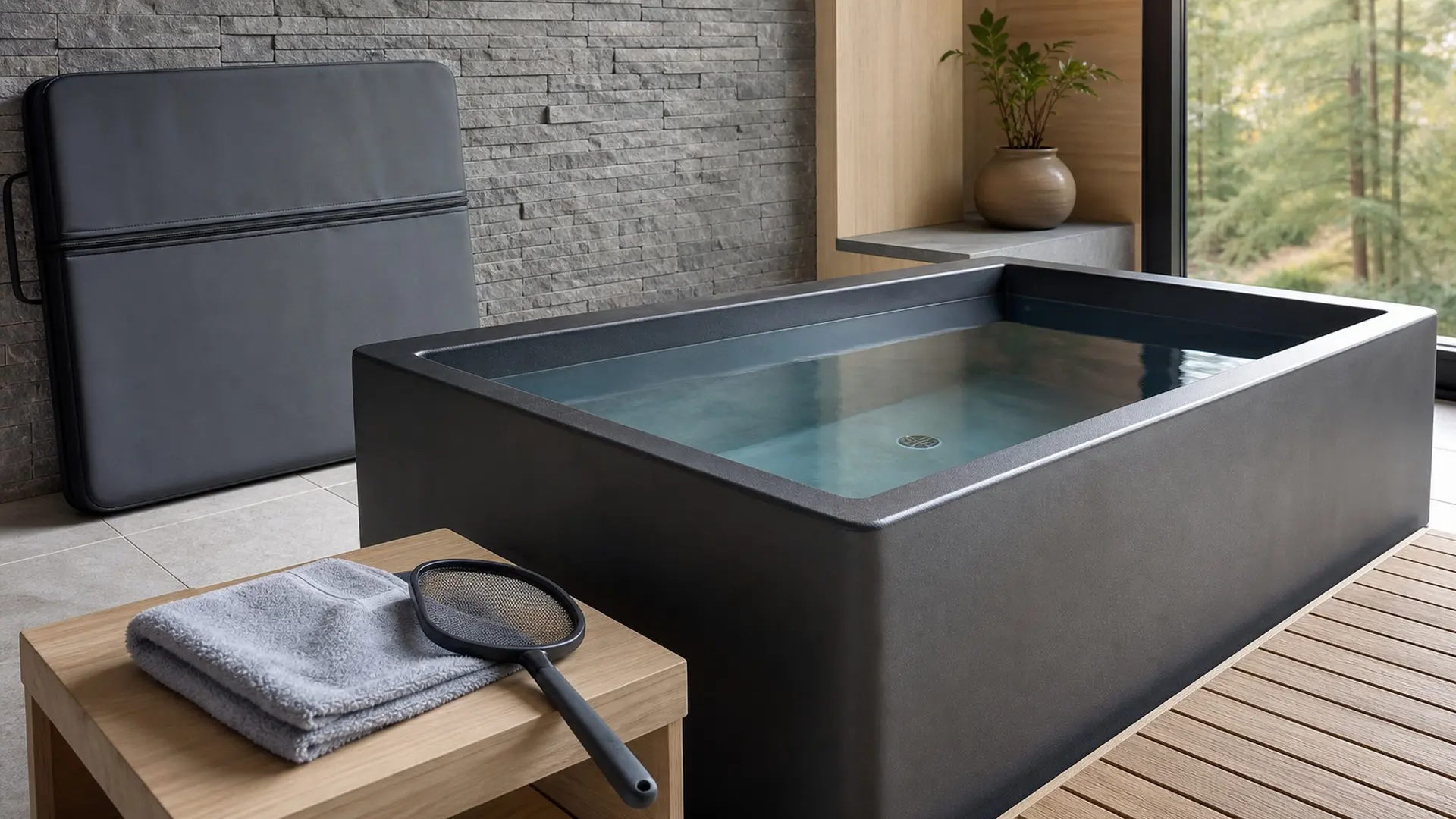
Use a fitted cover whenever the tub is idle; it keeps out leaves, dust, insects, pollen, and other airborne debris that can clog the filter or settle on the floor.
Check and wipe the underside of the cover with warm water and a soft cloth when residue appears. Let it dry before replacing it so the cover does not drip dirt back into clean water.
One home user and a busy recovery studio create very different contamination loads. As user numbers rise, inspect the waterline and return flow more often, check the filter sooner, and shorten the interval between condition checks.
For a shared facility, assign one person per shift or operating period to record water condition, flow, filter service, cleaning, and any closure. Do not copy a household schedule into a commercial setting without considering local health requirements and the exact equipment design.
2. Keep Water Moving
Circulation carries contaminated water toward the filter, chiller, and any treatment device. If flow becomes weak, even good components cannot process the tub effectively.
When the system is clean and working correctly, observe the strength of the return stream and note how the water surface moves. This gives you a simple baseline for spotting a dirty filter, blocked intake, kinked hose, trapped air, or pump problem later.
Do not invent one universal daily runtime. Use the operating cycle specified for your tub volume, pump, plumbing, and treatment system, then confirm that water is actually returning steadily rather than assuming that pump noise means adequate circulation.
A mechanical filter captures hair, lint, insects, grit, and other suspended particles large enough for its media. It improves clarity and prevents this material from repeatedly passing through the pump and heat exchanger.
A filter does not remove every dissolved contaminant and cannot clean oil or film already attached to the waterline. This is why clear-looking filter media does not always mean the water or tub surface is clean.
Inspect the filter when return flow weakens, debris remains suspended, cloudiness increases, or the filter soils faster than usual. Before opening the housing, switch off or isolate the equipment exactly as its manual requires.
Remove loose debris first. Rinse a reusable cartridge only if its manufacturer permits it, using moderate water pressure that will not damage the pleats; replace disposable, damaged, misshapen, or persistently dirty media rather than trying to rescue it with household degreasers or bleach.
After reassembly, release trapped air if required and verify that normal return flow has come back. If flow remains weak with a clean filter, inspect the intake, hose routing, valves, fittings, and pump before returning the tub to use.

3. Use Ozone Correctly
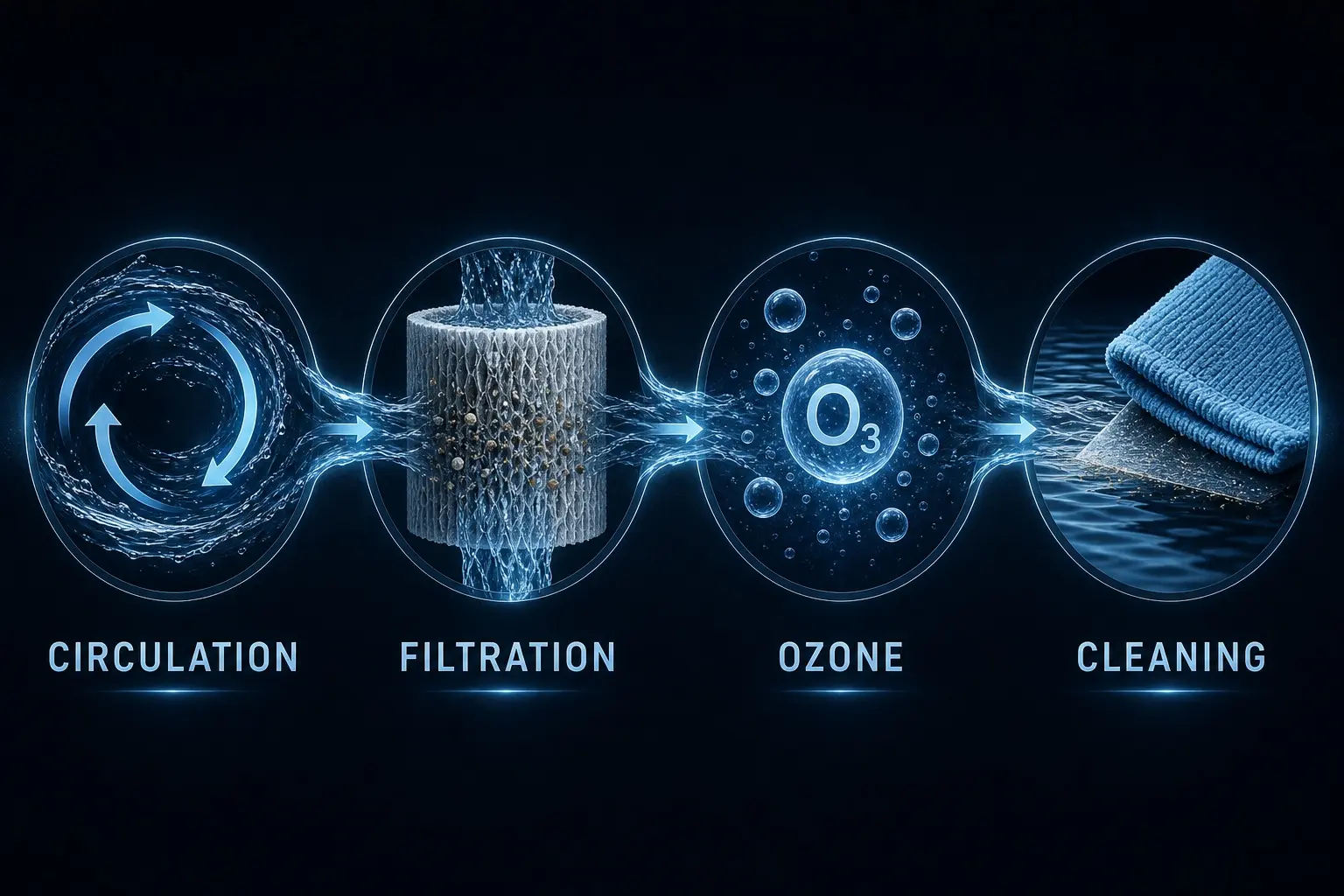
Filtration and ozone perform different jobs. The filter physically catches particles, while ozone adds an oxidation step to circulating water.
How Ozone Helps Keep Water Clean
Ozone helps keep cold plunge water cleaner by oxidizing some dissolved organic contaminants introduced by sweat, body oils, and other residues. In a properly designed circulating system, it can also help control susceptible microorganisms, reduce unwanted odors, and support clearer water between routine cleaning cycles.
This gives the system a treatment layer beyond mechanical filtration. The filter catches hair and visible particles, while ozone acts on some contaminants that the filter may not physically trap, helping slow the decline in water quality under regular use.
Check That Ozone Can Work
Ozone must be generated, mixed into moving water, and given enough contact under the system’s intended operating conditions. Its real effect depends on generator output, injector condition, flow, mixing, contact time, water condition, and maintenance.
Use only the installed operating cycle and connections specified for the system. If the unit has an indicator, injector, check valve, or replaceable ozone component, include it in routine inspections rather than assuming that the ozone system is working because circulation is running.
Know Its Limits
Ozone does not collect hair, leaves, grit, or sediment. It also cannot wipe body oil from the waterline, clean a dirty filter, remove established surface buildup, or replace a full water change when the water can no longer be restored.
Keep the ozone system correctly enclosed and ventilated as designed. If you notice a persistent sharp ozone-like smell around the tub or equipment, stop use, ventilate the area, and inspect the system rather than increasing its operating time.
Filtration vs. Ozone vs. Cleaning
These layers support one another. If one is missing or poorly maintained, the other parts of the system must handle more contamination.
4. Check After Use
A calendar is useful for reminders, but visible conditions tell you when the tub needs earlier attention. A brief check after use can stop a small problem from becoming a full drain-and-clean job.
Look for five changes before replacing the cover:
- Clarity: Can you see the bottom clearly, without haze or suspended debris?
- Odor: Does the water smell neutral rather than musty, sour, strongly chemical, or unusual?
- Surface: Is there foam, an oily sheen, discoloration, slime, or a ring at the waterline?
- Flow: Does the return stream match the normal clean-filter baseline?
- Filter: Is debris accumulating faster than expected, or is the cartridge overdue for inspection?
Remove a few floating particles with a clean skimmer and check the filter. If haze, odor, film, or foam remains or returns, do not hide it with fragrance or an unmeasured treatment product; inspect the contamination source, circulation, filter, and water condition.
Persistent foam often points to detergent from swimwear, cosmetics, body products, or accumulated organic residue. An oily ring usually calls for surface cleaning and better pre-entry rinsing, while weak flow points first to the filter or water path.
Cloudiness has several possible causes, so start with the simplest checks: remove visible debris, inspect the filter, verify return flow, and clean any surface film. If these steps do not restore acceptable water, stop use and move to water replacement or system inspection.
Shared facilities should record the date and time, water appearance and odor, return flow condition, filter service, tub cleaning, water replacement, unusual events, corrective action, and reopening decision. A one-page checklist or digital form is enough if staff use it consistently.
The log should reveal patterns. For example, repeated cloudiness after busy periods indicates that pre-entry controls, circulation, filter capacity, or inspection frequency needs adjustment—not that each cloudy-water event is unrelated.
5. Clean or Change Water
Filtration can extend usable water life, but it cannot keep the same water acceptable forever. When normal maintenance no longer restores clarity, odor, surfaces, and flow, clean the relevant parts and replace the water if necessary.
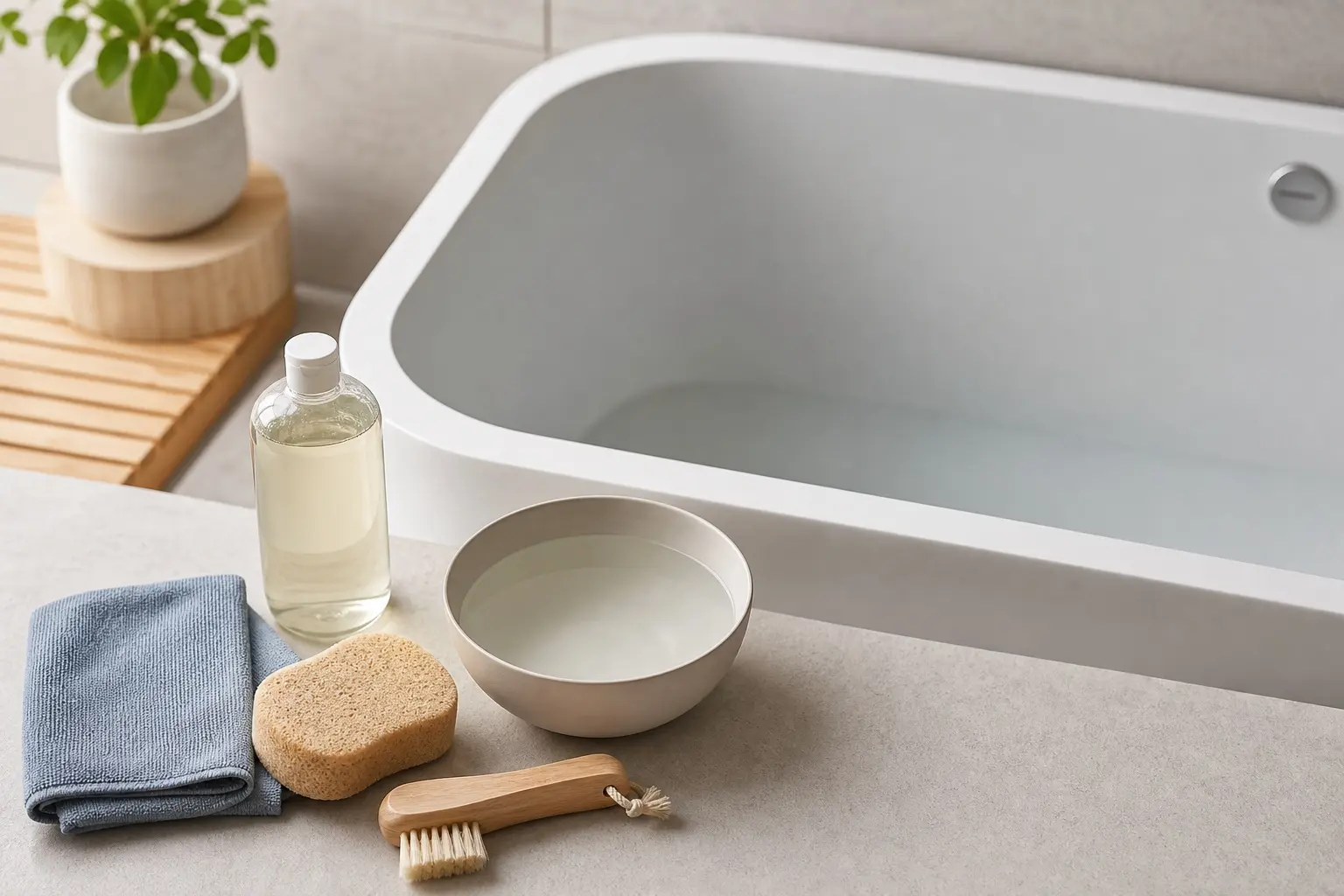
For routine cleaning of an emptied tub, start with the least aggressive option:
- Warm water
- A clean microfiber cloth
- A soft, non-abrasive sponge
- A soft nylon detail brush for corners, only if the surface manufacturer permits it
- A small amount of mild, unscented dishwashing liquid diluted in warm water
- Or a pH-neutral , non-abrasive tub or spa cleaner explicitly approved for the tub material
Plain warm water and a microfiber cloth are the safest first step for light residue. For a visible oily waterline, apply the diluted mild soap to the cloth—not directly into the plumbing—wipe the emptied surface, then rinse repeatedly until no suds, scent, or slippery film remains.
Do not use steel wool, scouring pads, abrasive powders, gritty pastes, or stiff wire brushes. They can scratch acrylic, plastic, coated metal, and other finished surfaces, creating rough areas that collect more residue.
Avoid concentrated bleach, strong acids or alkalis, solvents, essential oils, fragranced bathroom sprays, and high-foaming household cleaners unless the exact tub and equipment manufacturer approves them. Never mix cleaning products, and never add a surface cleaner while someone is using the tub or while the circulation system is running.
Vinegar, baking soda, hydrogen peroxide, and diluted bleach are common online suggestions, but none is universally safe across acrylic, inflatable materials, stainless steel, seals, hoses, filters, heat exchangers, and ozone components. Use one only when the instructions for the complete system confirm the product, concentration, contact time, and rinsing method.
- Switch off and isolate the equipment using the approved shutdown procedure.
- Drain the tub to a suitable location without creating a slip, electrical, or environmental hazard.
- Remove loose debris with warm water and a clean cloth.
- Wipe the waterline, corners, floor, inlet, outlet, and other accessible surfaces with the low-risk cleaning method above.
- Rinse until no cleaner, foam, fragrance, or slippery film remains.
- Inspect accessible seals, fittings, screens, and the filter housing while the system is empty.
- Reinstall serviced parts, close the drain, refill, release trapped air if required, and check for leaks.
- Restart circulation and confirm normal flow before anyone enters.
Do not pour a surface cleaner into hoses or internal lines to “flush” them. Use only a system-specific line-cleaning procedure and product approved for the pump, heat exchanger, seals, filter, and treatment components.
Replace the water when any of these conditions remains after a basic filter and flow check:
- Cloudiness does not clear
- An abnormal odor returns
- Foam or oily film quickly reappears
- Suspected contamination has occurred
- The system has been shut down for a prolonged period
- Circulation or treatment failed while the tub remained in use
- Water cannot be kept within the equipment’s required operating conditions
- Local rules require replacement in a shared facility
Do not keep adding unverified chemicals to avoid a water change. Draining, cleaning, and refilling is the correct reset when the existing water can no longer be maintained reliably.
6. Fix Common Problems
Start with observable causes rather than masking symptoms. If water quality is uncertain, close the tub until the cause has been checked and acceptable conditions have been restored.
Do not enter when the water is persistently cloudy, has a strong unexplained odor, shows slime or recurring film, or may have been contaminated. Keep the tub closed when circulation has stopped or an electrical, mechanical, or ozone-system fault is present.
A shared facility should reopen only after the cause has been corrected, normal circulation has been confirmed, the water meets applicable operating requirements, and the action has been recorded.
Clean cold plunge water comes from a repeatable sequence, not one accessory or chemical: Keep contaminants out, maintain steady circulation, capture particles, use ozone as a supporting treatment layer, and clean surfaces before residue becomes established.
The most reliable routine is also the simplest to troubleshoot: use low-risk cleaning tools, watch for visible changes, and respond to the first sign of declining flow or water quality. When those steps no longer restore the water, drain, clean, and refill instead of trying to cover the problem with more products.
Related Articles

FOCEEDO Partners with Nordu Spa in Türkiye
FOCEEDO and Nordu Spa begin a distribution partnership in Türkiye, adding FOCEEDO ice bath chillers to Nordu Spa’s cold-plunge range.

Meet FOCEEDO at AusFitness Industry 2026
Meet FOCEEDO at Stand 116 during AusFitness Industry, 11–12 September 2026 at ICC Sydney, and discuss cold recovery and partnerships.
Ice Bath Chiller Maintenance Guide for Commercial Facilities
Use this commercial ice bath chiller maintenance guide to build daily, weekly, and periodic checks for flow, filters, leaks, airflow, and water care.